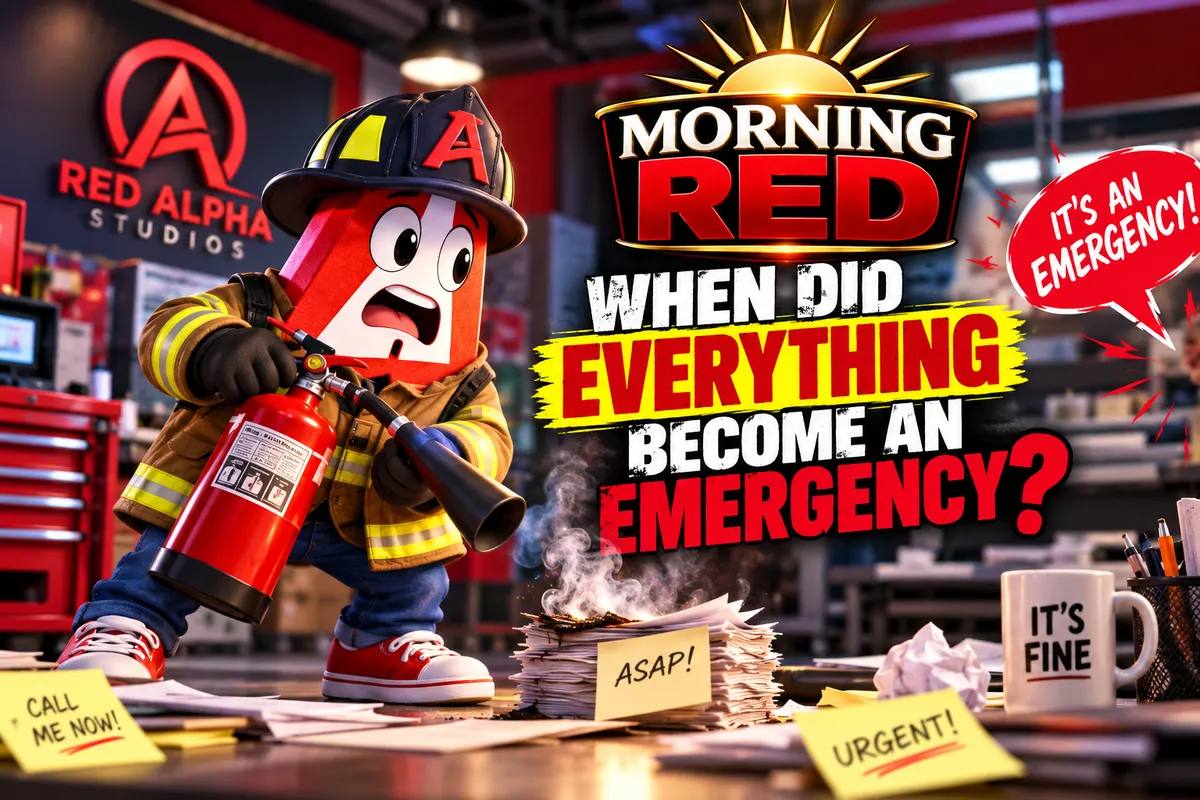
When Did Everything Become an Emergency? | Morning Red
🔴☕ MORNING RED
The “When Did...?” Series | Part 4
Thursday, October 22, 2026
Somewhere along the way, we started confusing urgency with importance. And now everybody's emergency seems to have our name on it!
☕ GOOD MORNING! WE HAVE AN EMERGENCY!
You ever notice how some people can't seem to communicate without making everything sound like a five-alarm fire? 🚒🔥
Your phone rings.
You answer.
“HEY! I NEED YOU TO DO ME A FAVOR! IT'S AN EMERGENCY!”
😳 Oh, man! What happened?
Is somebody hurt?
Did something catch fire?
Is somebody stranded on the side of the road?
Nope.
They need something printed for an event they knew about three weeks ago.
And the event starts in two hours! 😂
Now, don't get me wrong. We've all been there. Sometimes things really do sneak up on us.
But it does make you wonder...
🤔 WHEN DID EVERYTHING BECOME AN EMERGENCY?
And more importantly, when did someone else's emergency automatically become our responsibility?
📱🚨 WELCOME TO THE AGE OF URGENCY!
Take a look at how we communicate these days.
📧 EMAIL: URGENT! PLEASE RESPOND ASAP!
📱 TEXT: CALL ME NOW!
💬 MESSAGE: I NEED AN ANSWER IMMEDIATELY!
📞 VOICEMAIL: HEY, CALL ME! IT'S IMPORTANT!
And then you finally call them back...
“Hey! What are you doing this weekend?” 🤦♂️😂
Seriously?
I just mentally prepared myself for a national disaster, and you wanted to know if I was free Saturday?
We've become so accustomed to instant communication that we've started expecting instant availability.
And somewhere along the way, waiting for an answer became unacceptable.
But here's something worth considering.
Just because technology allows us to communicate immediately doesn't mean everyone is obligated to respond immediately.
There's a difference between being accessible and being available.
And there's definitely a difference between something being important to YOU and it being an emergency for EVERYBODY ELSE.
🧯 SOME FIRES DON'T NEED TO BE PUT OUT. THEY NEED TO STOP BEING STARTED!
Let's talk about something business owners understand all too well.
You start your morning with a plan.
You've got jobs scheduled, employees working, customers waiting, and a pretty good idea of what needs to get accomplished.
Then the phone rings.
Somebody needs something immediately.
So you stop what you're doing to help them.
Now the project you were working on is behind schedule.
Which creates another problem.
Which creates another phone call.
Which creates another emergency.
And before you know it...
🔥 YOU'VE SPENT YOUR ENTIRE DAY PUTTING OUT FIRES!
Here's the funny part.
Some of those fires didn't exist when you woke up that morning!
And some of them could have been avoided with a little planning, communication, or patience.
💡 Sometimes the biggest problem isn't the emergency. It's the chain reaction created when we treat everything like one.
🏃♂️💨 BUT WAIT... ARE WE PART OF THE PROBLEM?
Now here's where this conversation gets a little uncomfortable.
Because it's easy to point fingers at everybody else.
But let's be fair.
How many emergencies have WE created? 👀
How many times have we waited until the last minute to do something we knew needed to be done?
How many times have we told somebody, “I'll get that to you tomorrow,” without checking whether tomorrow was actually realistic?
How many times have we committed to something before thinking about everything else already on our schedule?
And how many times have we expected someone else to rearrange their day because we didn't manage ours?
Ouch! 😬
I know. That one stings a little.
But sometimes the person running around yelling “FIRE!” is the same person who left the matches lying around.
😂🔥
Accountability changes the conversation.
Instead of always asking why people keep bringing us emergencies, maybe we should occasionally ask whether we're creating some of them ourselves.
⚖️ NOT EVERY EMERGENCY IS A FALSE ALARM
Now, I don't want anybody walking away from this thinking we should stop helping people.
That's not the message.
Real emergencies happen.
🚑 People get sick.
🚗 Vehicles break down.
🏠 Homes suffer unexpected damage.
💼 Businesses experience equipment failures, staffing shortages, and circumstances nobody could have predicted.
And sometimes somebody really does need us to drop what we're doing and help.
Those are the moments when relationships, teamwork, and community matter most.
But here's the distinction.
When everything is treated like an emergency, it becomes harder to recognize the things that truly are.
If every email is marked urgent, the word loses its meaning.
If every project is the highest priority, nothing really has priority.
And if every request requires immediate attention, we're no longer managing our time.
We're simply reacting to whoever makes the most noise.
🧠 MAYBE WE'VE CONFUSED IMPORTANCE WITH URGENCY
Here's something I've been thinking about.
Not everything important is urgent.
And not everything urgent is important.
Think about it.
❤️ Spending time with your family is important. But it might not come with a flashing notification.
📚 Learning a new skill is important. But nobody may be demanding you do it today.
🛠️ Maintaining your equipment is important. But it's easy to postpone until something breaks.
📋 Building better systems is important. But it rarely screams for your attention.
Meanwhile, that notification on your phone is demanding you look at it RIGHT NOW!
And guess which one usually wins? 😂
The loudest thing in our lives isn't always the most important thing.
Sometimes the things that matter most are the things quietly waiting for us to make time for them.
⏰ WHAT IF WE STARTED ASKING BETTER QUESTIONS?
Imagine if, before declaring something an emergency, we asked ourselves a few simple questions.
🔍 Is this actually urgent, or do I just want it done right now?
📅 Could this have been avoided with better planning?
🤝 Am I asking for help, or am I transferring my problem to someone else?
🧭 What happens if this waits an hour, a day, or even until tomorrow?
Those questions won't eliminate every emergency.
But they might help us distinguish between a genuine crisis and an inconvenience.
And sometimes, the most productive thing we can do is simply say:
“I understand this is important. Let's figure out when we can realistically get it done.”
Not everything requires panic.
Not every problem requires an immediate solution.
And not every request deserves to jump ahead of commitments we've already made.
🔴 HERE'S MY MORNING RED THOUGHT
I believe in helping people.
I believe in showing up when someone needs us.
And I believe there are times when we should absolutely put aside our own plans to help somebody else.
But I also believe we've created a culture where being available is sometimes mistaken for being obligated.
Where impatience gets dressed up as urgency.
And where poor planning can become everybody else's problem.
Maybe the answer isn't to stop responding to emergencies.
Maybe it's to stop creating so many unnecessary ones.
Because the truth is...
🚨 NOT EVERYTHING IS A FIVE-ALARM FIRE!
Sometimes it's just somebody who forgot to buy the matches yesterday. 😂
And maybe everything wouldn't feel like an emergency if we stopped treating everything like one.
💬 NOW IT'S YOUR TURN!
When did everything become an emergency?
Have you noticed people expecting immediate responses and last-minute solutions?
Or have you caught yourself creating a few unnecessary emergencies of your own?
👇 Let's hear your thoughts in the comments!
And if you don't respond immediately...
DON'T WORRY. IT'S NOT AN EMERGENCY! 🤣
❤️ LIKE | 💬 COMMENT | ↗️ SHARE
🔴 MORNING RED | RED ALPHA STUDIOS
Real People. Real Stories. Real Conversations.
#MorningRed #WhenDid #RedAlphaStudios #SmallBusiness #Entrepreneurship #TimeManagement #BusinessLeadership #Communication #AbileneTX
