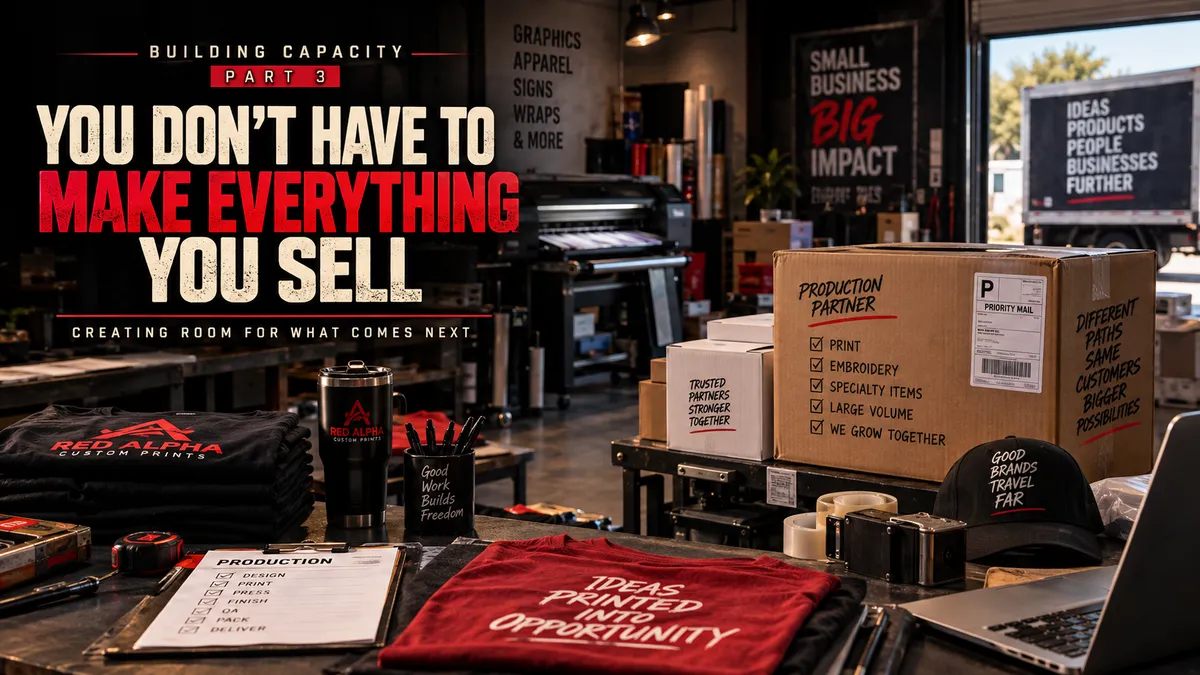
You Don’t Have to Make Everything You Sell | Building Capacity Part 3
You Don’t Have to Make Everything You Sell
There is a sentence that can be surprisingly difficult for a business owner to say:
“We don’t make that here.”
Especially when you know how to make it.
You have the equipment.
You have the knowledge.
Maybe you’ve produced it hundreds of times before.
So when an order comes through the door, the natural reaction is:
Of course we’ll make it.
But as a business grows, another question becomes just as important:
Should we?
Yesterday we talked about how capacity isn’t just equipment.
Buying another machine can create capacity. Hiring another employee can create capacity. Adding more space can create capacity.
But sometimes capacity is created by changing how the work gets done.
And one of those changes can be deciding that your business does not have to physically produce everything it sells.
WE USED TO THINK MAKING IT OURSELVES WAS THE POINT
There can be a certain pride that comes with doing everything in-house.
We printed it.
We cut it.
We finished it.
We installed it.
We made the whole thing.
And there is nothing wrong with that.
Knowing how to produce something gives you an understanding of the product that is difficult to replace.
But eventually, doing everything yourself can create a strange situation.
Your equipment is running.
Your people are busy.
Orders are moving.
Everybody is working.
And somehow the business still doesn’t have enough room for the work you actually want.
The problem may not be a lack of capacity.
The problem may be what you are using your capacity for.
EVERY JOB USES MORE THAN MACHINE TIME
It is easy to look at an order and think about how long it takes to print.
Twenty minutes.
An hour.
Maybe two hours.
But production time isn’t the whole cost.
Someone has to receive the order.
Prepare the file.
Load the material.
Run the equipment.
Finish the product.
Package it.
Handle mistakes.
Reprint something when necessary.
Answer questions.
Keep track of the deadline.
And while all of that is happening, something else is occupying the same people, equipment and attention.
That is capacity too.
Sometimes the question isn’t:
Can we make this?
It is:
What are we unable to make while we are making this?
That is a very different question.
A PRINT PARTNER CAN STILL BE PART OF YOUR PRODUCTION SYSTEM
There was a time when outsourcing something could feel almost like admitting your business couldn’t do it.
But that isn’t necessarily what it means.
A reliable production partner can simply become another part of your production system.
You still own the customer relationship.
You still determine what you are willing to sell.
You still establish the quality standard.
You still solve the customer’s problem.
The difference is that someone else may handle part of the manufacturing.
That can allow a small business to offer more without needing to own every machine required to produce everything it offers.
More importantly, it can protect the equipment, people and time you already have for the work where they create the most value.
That isn’t necessarily giving work away.
Sometimes it is buying capacity.
BUT OUTSOURCING DOESN’T AUTOMATICALLY CREATE CAPACITY
There is another side to this.
Sending work somewhere else is not automatically a good decision.
If the quality isn’t dependable…
If turnaround times are unpredictable…
If communication creates more work than the production would have…
If margins disappear…
If you spend all day fixing someone else’s mistakes…
You didn’t create capacity.
You created another bottleneck.
A production partner only increases your capacity when the relationship itself is reliable.
That means the decision cannot simply be:
Can somebody else make this cheaper?
The better question is:
Can this work move outside our building while we still protect the customer experience, quality and profitability?
If the answer is yes, something interesting happens.
Your building gets bigger without adding a square foot.
CAPACITY IS ABOUT CHOOSING WHERE YOUR RESOURCES MATTER MOST
This is where the conversation becomes bigger than outsourcing.
Every business has limited resources.
Equipment.
People.
Space.
Money.
Time.
Attention.
The goal isn’t necessarily to keep all of those resources busy every minute.
The goal is to use them where they create the most value.
Maybe your equipment should be producing the work where your turnaround time gives you an advantage.
Maybe your team should be concentrating on projects that require craftsmanship or customization.
Maybe another company can manufacture a standard product more efficiently than you ever could.
And maybe your job is not to prove that you can make everything.
Maybe your job is to build the best possible way to deliver what your customer needs.
Those are not always the same thing.
YOU CAN SELL MORE WITHOUT DOING MORE
That sounds backwards at first.
But it may be one of the most important ideas in building capacity.
Growth does not always require adding more work inside the business.
Sometimes growth comes from becoming more intentional about which work belongs there.
Yesterday we asked:
What could change about the way the work gets done?
Today we can make that question more specific.
Look at the things your business currently produces.
Then ask:
What do we make because we should make it?
And:
What do we make simply because we always have?
The answers might not immediately change anything.
But they might reveal capacity that has been sitting inside your business the entire time.
Because sometimes creating room for what comes next doesn’t require another machine.
Sometimes you just need to stop asking:
“Can we make it?”
And start asking:
