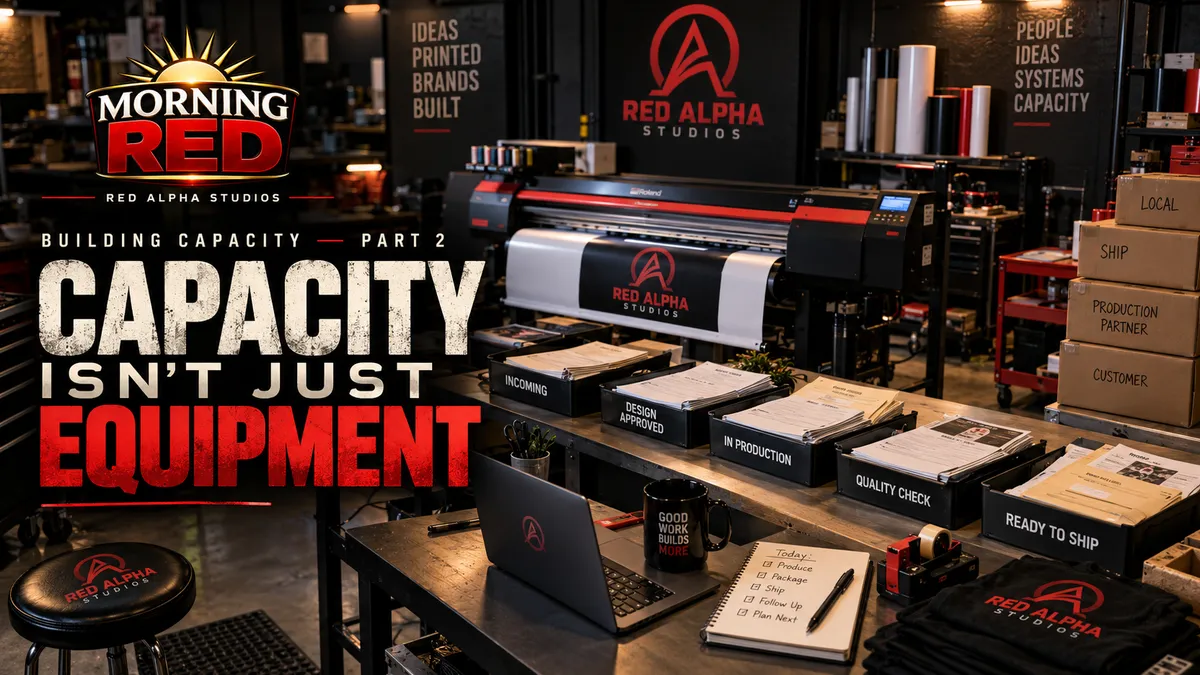
Capacity Isn't Just Equipment | Building Capacity Part 2
Capacity Isn't Just Equipment
When business owners talk about increasing capacity, the conversation usually turns toward things.
Another machine.
More equipment.
A larger building.
Another employee.
More inventory.
And sometimes those things are exactly what a business needs.
But there's another kind of capacity that can be much easier to overlook.
The capacity created by changing how the work gets done.
WHAT CAN YOUR BUSINESS ACTUALLY CARRY?
Capacity isn't simply how much equipment you own.
It's how much good work your business can reliably handle without breaking the people, systems or resources carrying it.
A shop can own three printers and still have a capacity problem.
A company can have plenty of employees and still have a capacity problem.
A business can even have enough customers, enough equipment and enough revenue—and still feel like it can't take on anything else.
Because sometimes the bottleneck isn't production.
Sometimes it's the process.
Sometimes it's communication.
Sometimes it's the type of work you're accepting.
Sometimes it's a task that still depends on one particular person.
And sometimes it's the belief that your business has to do everything itself.
MORE ISN'T ALWAYS THE ANSWER
When a business reaches its limit, the natural response is often:
We need more.
More equipment.
More people.
More space.
More hours.
But before adding something, it may be worth asking:
Why are we at capacity in the first place?
Maybe the answer really is another machine.
But maybe one machine spends too much time producing work that isn't particularly profitable.
Maybe an employee is spending hours doing something that could be handled differently.
Maybe the owner has become the approval point for too many decisions.
Maybe a reliable partner could handle part of the production.
Maybe certain jobs consume so much time and attention that they're preventing the business from accepting better opportunities.
Those aren't necessarily equipment problems.
They're capacity decisions.
CAPACITY CAN COME FROM WHAT YOU STOP DOING
This one can be difficult for business owners.
We tend to think growth means adding.
Sometimes growth comes from removing.
A service.
A step.
A responsibility.
A bottleneck.
A type of customer.
A job that consistently consumes more than it contributes.
Every business has limited resources.
Time is limited.
Attention is limited.
Equipment time is limited.
People are limited.
And the owner's energy is definitely limited.
When those resources are constantly being consumed by the wrong things, there isn't much room left for the right things.
Removing one unnecessary demand can sometimes create more usable capacity than purchasing another piece of equipment.
CAPACITY CAN COME FROM OTHER PEOPLE
There's another idea that many entrepreneurs struggle with:
Someone else can do part of the work.
That doesn't automatically make the business less capable.
Sometimes it makes the business more capable.
A good employee can increase capacity.
A contractor can increase capacity.
A vendor can increase capacity.
A production partner can increase capacity.
Technology can increase capacity.
Automation can increase capacity.
The question isn't always:
“Can we make this ourselves?”
A better question might be:
“What is the best way for us to deliver this well?”
Those are very different questions.
PROTECT THE THINGS ONLY YOU CAN DO
This becomes especially important for owners.
There are probably things inside your business that only you can do—or that you do unusually well.
Maybe it's selling.
Building relationships.
Creating.
Leading people.
Recognizing opportunities.
Solving unusual problems.
Setting direction.
But owners frequently spend enormous amounts of time doing work that someone—or something—else could handle.
Every hour spent there consumes capacity too.
Not machine capacity.
Leadership capacity.
And that may be one of the most expensive forms of capacity a growing business can waste.
BUILD ROOM BEFORE YOU NEED IT
Yesterday we asked:
What are you standing on?
Because growth needs a foundation capable of carrying it.
Today the question goes one step further.
How much can that foundation actually carry?
Not theoretically.
Not if everyone works late.
Not if the owner personally holds everything together.
Not if nothing goes wrong.
How much can the business reliably carry?
Because real capacity isn't about squeezing one more job into the schedule.
It's about creating enough room that when the next opportunity appears, the business can actually say:
Yes. We can handle that.
And sometimes creating that room doesn't require buying anything.
It requires changing the way the work gets done.
So before you ask what you need to buy next, ask a different question:
WHAT COULD CHANGE ABOUT THE WAY THE WORK GETS DONE?
Tomorrow:
BUILDING CAPACITY — PART 3
YOU DON'T HAVE TO MAKE EVERYTHING YOU SELL
Your business is still talking. Keep reading. 🔴
